
In July 1776, in the stifling heat of the Philadelphia Statehouse, the nation’s Founding Fathers cast their votes to declare independence from Great Britain. Meanwhile, 300 miles north, American soldiers were returning from an unsuccessful campaign to take Quebec City.
The defeated army retreated to a burnt-out fort at Crown Point on Lake Champlain. They returned with more than battle wounds. They brought with them a highly contagious and deadly virus, the Speckled Monster — smallpox.
The Army moved to Fort Ticonderoga, and the sick were sent on to Fort George at the southern end of Lake George, where a smallpox hospital was established. More than 3,000 were treated at the hospital during the summer and fall of 1776. As many as 1,000 died. The remains of 44 individuals discovered in an unmarked cemetery in Lake George Village in 2019 are believed to have been among the hospital’s patients.
The Lake George Battlefield Park Alliance commemorated the smallpox hospital’s 250th anniversary Thursday evening with an event held at the Fort William Henry Hotel Conference Center. A panel of three gave presentations in their areas of expertise, laying out the events from late 1775 to the summer of 1776, telling the stories of the invasion of Canada, the retreat to Crown Point, the decision to send the sick to Fort George, and the nature of smallpox and how it devastated the Continental Army before George Washington mandated inoculation.

Dr. Michael Gabriel, former Kutztown University of Pennsylvania history professor and author of “Major General Richard Montgomery: The Making of an American Hero,” opened the program with a discussion of the Quebec invasion and what it had to do with smallpox.
What happened in Canada?
To understand the invasion of Canada, we have to backtrack to May 10, 1775, when Ethan Allen and Benedict Arnold seized Fort Ticonderoga from the British. “And equally important,” says Gabriel, “they raid Skenesborough, they seize Crown Point, and Benedict Arnold seizes, temporarily, this place in Canada called St. John’s.” This “opens the door to the invasion of Canada.”
Congress debated whether to invade Canada. It had only been a few weeks since Lexington and Concord; “Americans really aren’t sure if independence is the final decision here,” says Gabriel.
They did believe that many French Canadians would join the Americans in their fight. The Canadians had only been British subjects for 12 years. Additionally, the Governor of Canada, Guy Carlton, was rumored to be assembling troops and warships, which threatened the American colonies. Considering those factors, Congress gave the go-ahead for invasion in June 1775.
The plan was for a two-pronged approach, with General Richard Montgomery’s army taking the traditional route up Lake Champlain to Montreal. They arrived at Montreal on November 11 and two days later entered the city. Carlton evacuates the city. The fall of Montreal, says Gabriel, is a very important victory as it cuts off all the British outposts in the Great Lakes.
Arnold led a second force through the Maine wilderness, a 20-day, 180-mile trek, according to an old map, that would allow a quick, surprise strike on Quebec City. Governor Carlton would be too busy defending Montreal to notice, Arnold believed.

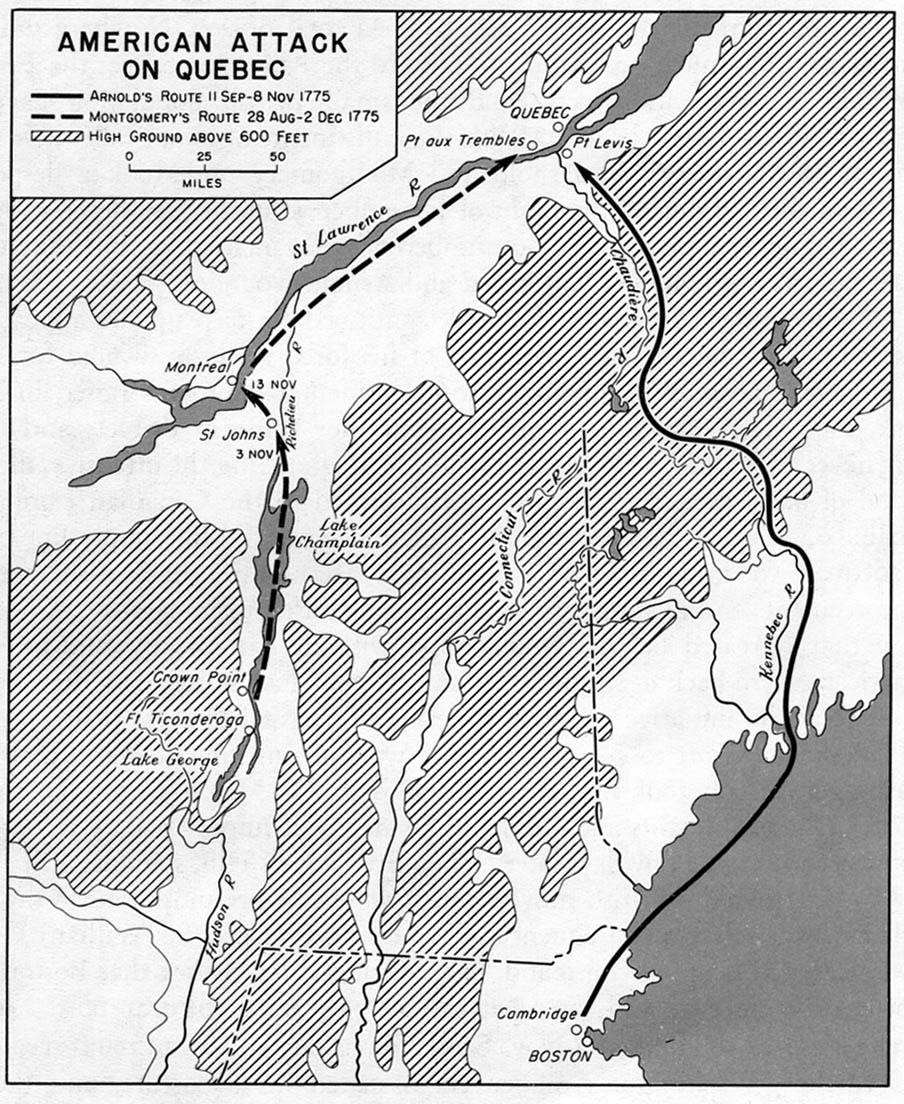
“Instead,” said Gabriel, “what we see happen is that it’s somewhere close to about 300 miles, and it takes about six or seven weeks. And they encounter horrific weather. They encounter a hurricane that raises the Dead River eight feet overnight and washes away most of their equipment.”
Arnold’s force of 1,100 is reduced to about 600 as the rear guard turns back, carrying off provisions. Some men starve to death. By the time they cross the St. Lawrence River, the troops are undernourished and low on ammunition. Arnold must fall back and wait for Montgomery’s force to arrive. This happens on December 1, 1775.
“It’s a very, very cold winter, and Montgomery does not have the equipment for siege warfare, especially in winter. So, he has artillery, but the artillery is so light the cannonballs bounce off the walls of Quebec.” They must storm the city, and they had to do it soon. Two-thirds of enlistments in Arnold’s army were set to expire by the end of the month.
“The attack takes place in the early morning hours, about 6 A.m., December 31st, in a howling blizzard, and it’s a disaster. Richard Montgomery is killed almost immediately,” says Gabriel. Arnold’s men fight their way into the city. Arnold is wounded and must leave the field. His troops were expecting Montgomery’s men to join them, but when Montgomery was killed, his men had retreated. The invasion fails.
Congress remains committed to taking Quebec, and sends reinforcements to Montreal, the first arriving in February, but supplies and money begin to run out. Smallpox is beginning to take its toll. Montgomery’s army experienced a small outbreak in December, but it was contained by quarantining the infected.
The epidemic began to take hold following Montgomery’s death. Arriving reinforcements were infected. Against orders, some soldiers began to inoculate themselves, and their failure to quarantine accelerated the spread as they passed the infection from their wounds to their comrades. By May, of the 2,000 American soldiers outside of Quebec, 1,200 were sick, most with smallpox.
On May 6, 12,000 British reinforcements arrived in Quebec City. The Americans had been planning a retreat, “… but the arrival of British reinforcements turned the retreat into a rout,” says Gabriel.
The Americans ultimately had to abandon their designs on Canada and return to Crown Point and Ticonderoga, with hundreds dying of smallpox on the way.
From Crown Point to Fort George: Smallpox hospital established on Lake George
The next speaker, Crown Point Historic Site Manager Sam Huntington, picked up the story. Hundreds of sick soldiers arrived at Crown Point. One soldier who was there for eight days in July, Huntington said, wrote that 15 to 20 people were being buried at Crown Point each day.
The American-held Fort at Crown Point is located on a Lake Champlain peninsula. It’s a strong position to hold for defending against British troops coming down from Canada. However, a 1773 fire left the fort in ruins.
Five generals — Benedict Arnold, Horatio Gates, John Sullivan, Philip Schuyler, and Baron De Woedtke, a Prussian officer who had volunteered for the American Revolution — convened a war council on July 7 and concluded that re-fortifying Crown Point was untenable. They resolved instead to move to Fort Ticonderoga and send the sick further south to Fort George, where they would establish a hospital.

The Speckled Monster
The final speaker of the evening was infectious disease specialist Dr. Richard Leach, who discussed smallpox in the history of infectious diseases, the painful and scary (it was called the Speckled Monster) symptoms of the disease, the suffering of infected troops at Fort George, how George Washington was able to get the virus under control, and how mankind finally eradicated the virus.
“The systemic symptoms, which are fever, intense backache, and generalized myalgias or muscle aches, terrible headache, that sort of thing, and it could be anything,” Leach explained. These symptoms would appear nine to 20 days after exposure. “It wasn’t until the rash broke out a couple of days later that it was clearly diagnosable as smallpox.”
The virus is spread through respiratory droplets; a cough or a sneeze would shower the virus out six or eight feet. The rash starts in the mouth, pharynx, and respiratory tract. “[I]t makes things incredibly difficult to swallow, to eat, to drink. The tongue swells. People had a hard time talking.”
The rash develops into white, pus-filled pustules that cover the patient’s face and extremities. “When that happens, and the pustule starts to break down, there comes to be a terrible smell that was characteristic of smallpox. It was called smallpox fetor.” As the pustules erupt, the virus can be spread through contact. Someone tending to a patient who is oozing pus can pick up the virus on their hands and transmit it to their mouth. The patient’s bedding can become infected and even serve as a bio-weapon.

For the patient, what follows is either recovery or death. Leach calls smallpox an old-world disease. A 3,000-year-old mummified child in Egypt showed evidence of smallpox, but Leach says the virus may have begun spreading through humans 11,000 years ago when people began domesticating animals. “It probably came over from a wild bovine of some sort … and a curiosity of the smallpox, the variola virus, is that when it came over [to humans], it decided never to go back to animals. So, it was strictly a viral infection of people.”
It did not exist in the New World until the conquistadors, and then colonists, carried it with them across the ocean. Europeans, Africans, and Asians had been exposed to smallpox for thousands of years and carried some inherited immunity, so that their fatality rate was relatively low at 30 percent. Indigenous populations had no natural immunity, and the disease nearly wiped out the Native Americans. “Maybe as many as 90 percent of the population of Native Americans in North and South America were killed principally by smallpox, not by the rifle or the sword,” Leach said.
Life and death at the Fort George smallpox hospital
The hospital at Fort George was established in July 1776, and most likely was a series of hastily constructed outbuildings, and its exact location at the head of Lake George is unknown.
The most recent attempt to locate the hospital was an archaeological survey conducted in June 2024 by Professor Siobhan Hart of Skidmore College. That spring, Hart’s team focused on a section of Battlefield Park east of Fort George Road. They found no evidence of a medical facility there.

Historian and former President of the Lake George Battlefield Park Alliance, Dr. Lyn Karig Hohmann, says she and others believe, based on documentation describing sheds on the shoreline at that time, the hospital would have been built further away from Fort George, beyond what is now Battlefield Park, closer to the ruins of the original Fort William Henry. “Presumably, since Fort George was an active military fort, you don’t want your sick guys anywhere near the grounds of Fort George,” Hohmann said. She also noted that though it’s commonly referred to as a smallpox hospital, it was more of a general hospital treating a multitude of illnesses.
Leach described what conditions would have been at the Fort George hospital. “We think that there may have been two long log houses capable of housing about 350 men, and there was no foundation. There were floorboards, wind passing under. The floorboards, of course, weren’t beds. What people did was they were laid on the floor on blankets. Maybe they had a pillow. Maybe they had a towel or rag or something. You’d put it over a pair of boots or something for a pillow. You can imagine how minimal it was and then how packed it became.”
Revolutionary War physician Dr. Jonathan Potts, who served at the hospital, wrote of the distressful situation of the sick without clothing, or bedding, or shelter sufficient to screen them from the weather — “Uppers of one thousand sick and wounded in the sheds, laboring under the various disorders of dysentery, bilious, putrid fevers, and effects of confluent smallpox.”
There was not a lot that could be done for the patients. “It’s really hard to imagine the suffering of the individuals who were lying out on those board floors, you know, cheek by jowl, very little care, very little medication, couldn’t be cleaned because when you try to wipe a person with a rash like that, it’s going to be so painful,” said Leach. Two medicines were effective in addressing symptoms. Laudanum worked well to kill pain, and willow and chinchona bark were effective in reducing fever. However, the fatality rate, Leach says, may have been as high as 50 percent.
Variolation – The first public health mandate in the United States
Before the winter of 1778, Leach says, it’s estimated that 90 percent of troops were killed not by musket balls but by disease. Variolation, a procedure where a controlled amount of the virus is introduced to a body through a small cut or puncture wound to create an immune response, was known in the colonies. The term Variolate comes from the name of the smallpox virus, Variola.
In 1721, there was an active smallpox epidemic in Boston. Clergyman Cotton Mather learned of the procedure from his slave, a man named Onesimus, who was from what is now Ghana, where variolation was a standard practice. Onesimus had been inoculated and was immune.
Mather enlisted the help of Boston physician Zabdiel Boylston to introduce variolation to the colonies. Benjamin Franklin, John and Abigail Adams were among those who underwent the procedure, and the practice spread to other colonies.
George Washington initially rejected variolation for his troops. He preferred to quarantine, fearing a program of intentionally making soldiers sick would spread the disease. Men who underwent the procedure would become ill and had to be quarantined for several weeks as their immunity built. Additionally, variolation had a 3 percent mortality rate. Those who are already in poor health may die from the procedure.
In February 1977, as the infection continued to spread through his army, Washington changed his mind and mandated inoculation for all members of the Continental Army. It was the first public health mandate in the United States. By the end of the year, 40,000 soldiers had been variolated.
“Many historians consider this decision to be the most important decision that Washington made,” Leach said, “and they mark it as a turning point in the Revolution.” Washington’s actions prevented epidemics in the ranks of the troops, and those who wished to serve in the army were more likely to sign up knowing the threat of contracting the disease was greatly reduced.
Towards the end of the 18th Century, English physician Edward Jenner developed a vaccine from the cowpox virus, a virus very similar to smallpox, but not deadly to humans. He had observed that milkmaids, who were exposed to cowpox through cracks in the skin of their hands, were immune to smallpox. Unlike variolation, vaccination had a zero percent mortality rate, and a vaccinated person is not contagious.
In the 1920s, an aggressive campaign to spread the vaccine throughout the world entirely eradicated smallpox. The last case was recorded in 1977 in an Ethiopian boy, who survived.
Dr. Leach closed his presentation saying it is important to remember the suffering these soldiers endured and to understand why they had the courage and willingness to die for the cause. Leach displayed a slide showing a knapsack on exhibit at Fort Ticonderoga. The Warner Knapsack belonged to Benjamin Warner, a Connecticut soldier who carried it from the invasion of Quebec through the retreat to New York and kept it with him as he fought in many American Revolutionary War battles.
Warner left his knapsack to his children with the words, “… Whilst one shred of it shall remain never surrender your libertys to a foren envador or an aspiring demegog.”
In the coming weeks, a video of the entire “Honoring the 250th Anniversary of the Fort George Smallpox Hospital” presentation will be posted on the Lake George Battlefield Park Alliance YouTube channel. To learn more about the Alliance and the role Lake George Battlefield Park played in history, visit the Lake George Battlefield Park Visitor Center, 75 Fort George Road, Lake George, New York.
Discover more from The Lake George Examiner
Subscribe to get the latest posts sent to your email.